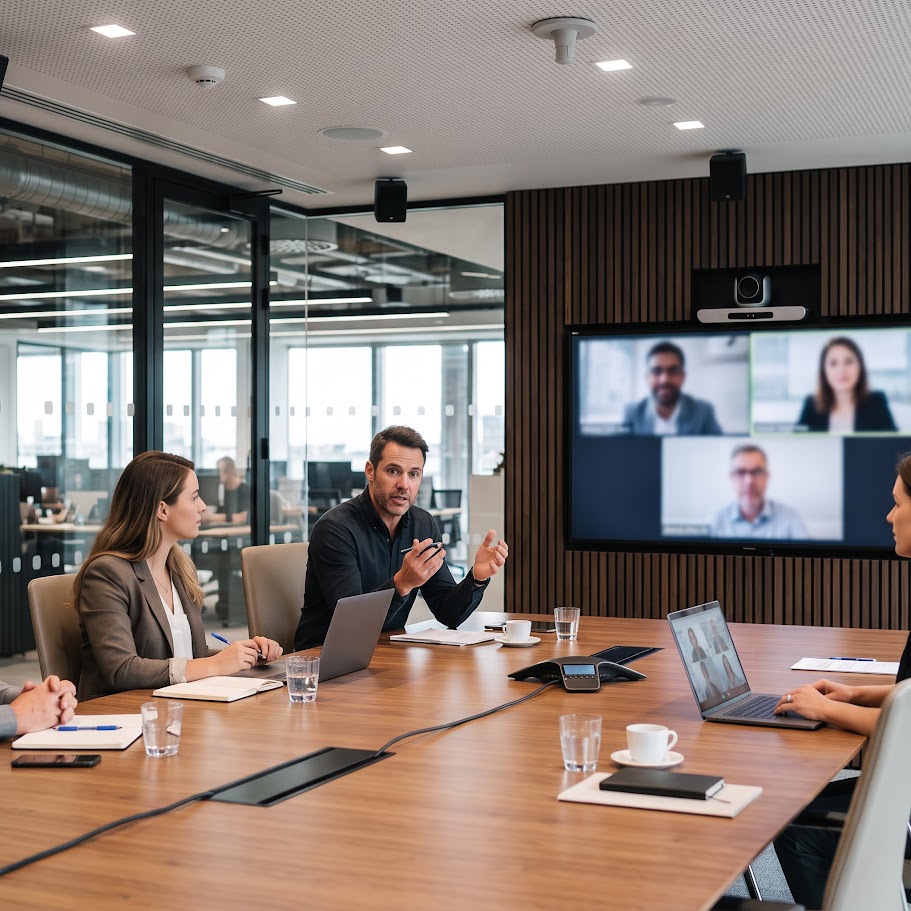
Hybrid meetings have made conference rooms more flexible, but they have also created a new challenge.
A meeting can look perfectly fine to the people sitting around the table while providing a completely different experience to someone joining remotely. The person at the end of the table looks tiny. Someone sitting outside the camera’s field of view barely appears. A quiet speaker isn’t picked up by the microphone. Side conversations become impossible to follow.
Everyone is technically in the same meeting, but they aren’t necessarily having the same meeting.
The distance from the camera matters
Traditional conference rooms often place a camera near the display at one end of a long table.
That arrangement can create a significant difference between the person sitting closest to the camera and someone at the opposite end of the room. Current AV discussions describe this as a form of distance bias, and it is one reason meeting room design is increasingly focusing on the remote participant’s perspective.
Before your next hybrid meeting, join the call from a laptop somewhere outside the conference room and look at what remote participants actually see.
Can you clearly see everyone?
Can you tell who is speaking?
Can you follow the conversation naturally?
The answers can be surprisingly different from what people inside the room experience.
Audio can matter even more than video
A beautiful video image doesn’t help much when remote participants can’t understand the conversation.
Microphone coverage needs to account for the entire seating area, not simply the people closest to the equipment. Room acoustics, background noise and speaker placement can also affect whether conversations feel natural.
In fact, current conference room planning guidance continues to emphasize audio as one of the most important elements of the hybrid meeting experience.
Smarter cameras can help, but they aren’t the entire solution
Newer conference room systems can use intelligent framing, speaker tracking and other capabilities to make participants easier to see. These technologies are becoming a major part of modern hybrid room design.
But adding an intelligent camera to a poorly designed room won’t automatically solve every problem.
Camera position, microphones, speakers, displays, acoustics, seating and the size of the room still need to work together.
Try experiencing your own conference room remotely
This is perhaps the simplest conference room test you can perform.
Don’t evaluate the room from the conference table.
Join your own meeting remotely.
Listen to the audio. Watch different people speak. See how easy it is to follow the conversation and shared content.
You may discover problems that aren’t obvious from inside the room.
A better hybrid meeting includes everyone
The goal of a modern conference room isn’t simply to connect remote participants.
It’s to make it easier for everyone to participate, whether they’re sitting six feet from the display or joining from another city.
If your remote participants regularly struggle to see, hear or follow what’s happening in the room, the issue may not be the meeting platform. It may be the room itself.
LSA can help evaluate your conference room environment and design an AV solution that creates a clearer, more consistent experience for both in room and remote participants.
Planning a project?
LSA Security can help evaluate your space and recommend a solution around your operational, security, AV, and infrastructure requirements.
KEEP EXPLORING