Walk into a gym at 6 a.m. and there may already be dozens of people moving through the space. Members are checking in, trainers are starting sessions, employees are opening different areas of the facility, and people are coming and going from the parking lot.
A few hours later, the same building may be significantly busier. And for a 24 hour facility, that cycle never completely stops.
That makes gyms a little different from many other commercial properties. They need to be easy for members to access without being easy for everyone to access.
Getting that balance right takes more than putting a camera above the front desk.
Start with how people actually use the facility
Before deciding where security cameras or access readers should go, it helps to look at how people move through the building.
Where do members enter after hours? Which doors are used by employees? Are there storage rooms or offices that should only be accessible to staff? What happens when the front desk is unattended? Are there exterior entrances that aren’t always visible from inside?
Those questions often reveal more about a facility’s security needs than starting with a list of equipment.
Where gym access control earns its keep
For many gyms, the front entrance is the obvious starting point. Access control can allow members and employees to enter using authorized credentials while giving management greater control over who can enter and when.
This becomes especially useful for fitness centers with extended or 24 hour access. Members can still enter without someone having to physically unlock the building, while management maintains a record of access activity.
One credential, four people through the door
Tailgating is the most common access problem in fitness facilities. One member badges in and two or three people walk in behind them.
At noon in a staffed gym, that may be a minor issue. At 2 a.m. in an unstaffed facility, it means people are inside the building with no record that they were ever there.
That gap is one of the largest blind spots in 24 hour gym security.
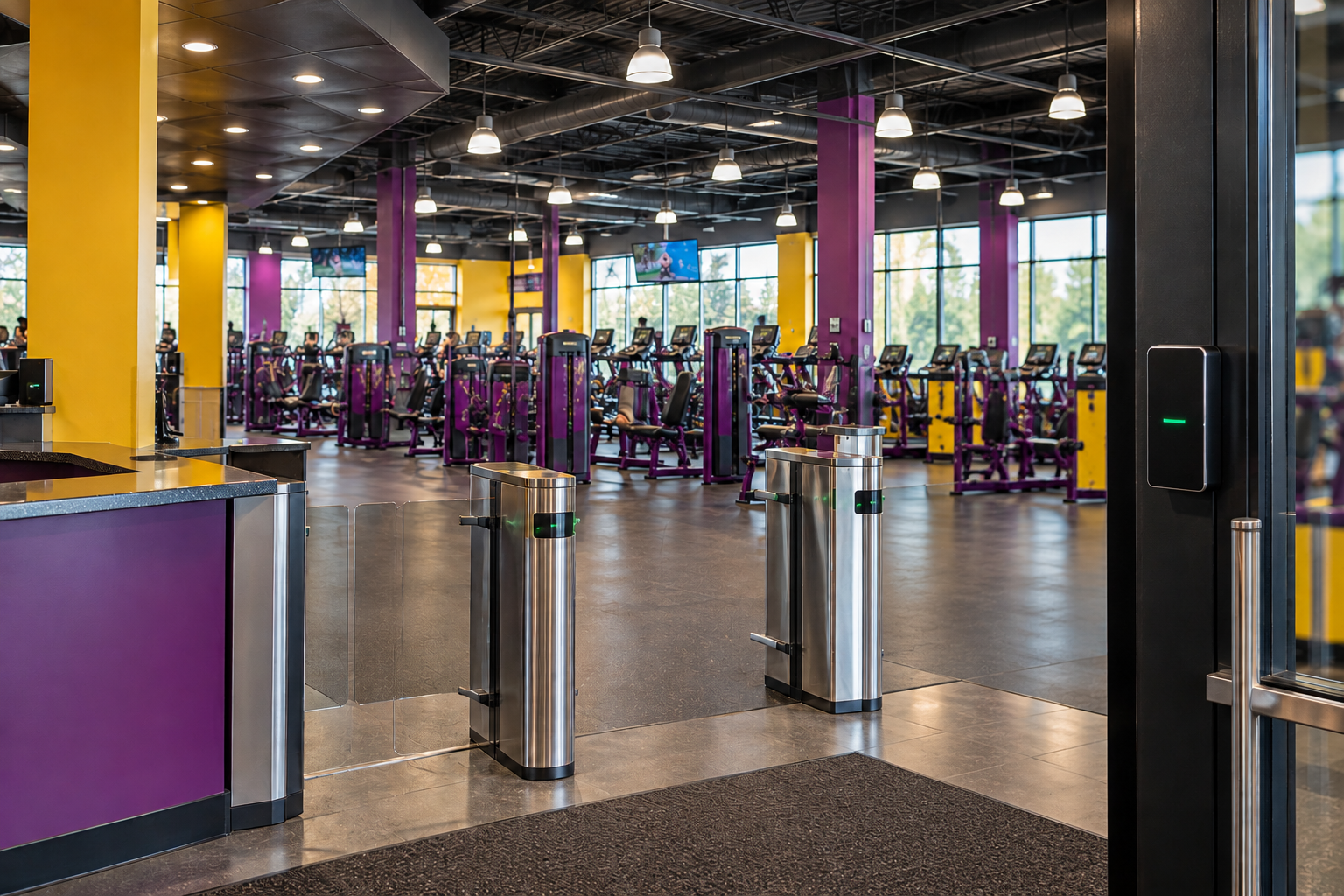
There are practical ways to reduce it. An entry vestibule. Turnstiles or speed gates at the main entrance. Cameras positioned to see the door from both sides. Access events that can be reviewed alongside video rather than on their own.
The right approach depends on the facility, the hours it operates and the experience management wants members to have. But the problem is worth addressing before it turns into an incident.
Cameras and access control are more useful when they work together
Video surveillance serves a different purpose.
CCTV and security cameras can provide visibility across entrances, reception areas, workout floors, exterior doors and parking areas. If something happens, recorded video can help staff understand what took place rather than relying entirely on memory or incomplete information.
There is an even greater advantage when video surveillance and access control are considered together.
An access system may show that a credential was used at a particular entrance at a particular time. Video from that area can provide additional context.
For a busy fitness facility, that can make reviewing an incident much more straightforward.
Of course, surveillance in a gym also requires common sense. Cameras belong in appropriate common and security sensitive areas, not in changing rooms, showers or other spaces where members expect privacy.
Good security shouldn’t change how the gym feels
This is an important distinction.
People aren’t walking into a gym expecting to think about security. They want to work out, meet their trainer, take a class or get on with their day.
Good security shouldn’t interfere with that experience.
A member shouldn’t have to go through an unnecessarily complicated process every time they enter the building. Employees shouldn’t need five different systems to manage doors, cameras and other technology. And equipment shouldn’t dominate the design of a well planned space.
Ideally, most members barely notice the security infrastructure at all.
It simply works.
Don’t forget what is behind the technology
Cameras, card readers and displays are the visible part of an installation. Much of what makes them reliable is hidden behind walls, above ceilings and inside equipment rooms.
Cabling, network connectivity, equipment placement and low voltage infrastructure all play a role.
That becomes particularly important when a fitness center is being built or renovated. Planning those systems early can be much easier than trying to add infrastructure after walls are finished and the facility is already operating.
It also makes future changes easier.
A gym may open with one set of requirements and later add another entrance, additional cameras, digital displays or new technology. Thinking about the infrastructure from the beginning gives the facility more room to grow.
One gym is different from twenty
The conversation changes again for fitness companies operating multiple locations.
A single facility can often solve problems as they arise. At ten, twenty or fifty locations, those individual decisions start becoming difficult to manage.
One location has cameras installed one way. Another uses different equipment. Cabling is labeled differently. Access points are in different places. Documentation varies from installer to installer.
None of those differences may seem significant on their own. Together, they can make expansion and support unnecessarily complicated.
Standardization helps.
Establishing consistent expectations for installation, equipment, documentation and testing makes it easier to repeat a successful approach as new locations open.
This is also where working with an installation partner capable of coordinating projects across markets can become valuable. Instead of rebuilding the installation process every time a new location opens, organizations can work from an established standard.
Where LSA Security fits in
LSA Security installs the technology fitness businesses depend on, whether the project involves one facility or sites across several states. That can include CCTV and video surveillance, access control, alarm systems, network and low voltage infrastructure, commercial AV and digital signage.
The equipment itself is only part of the job. How those fitness center security systems fit the building, how staff use them every day and how easily they can be supported as the business changes usually matter more than the spec sheet.
A small studio doesn’t have the same requirements as a large health club. A gym that closes every night doesn’t operate like a 24 hour facility. The solution should reflect those differences.
The best security is often the security members don’t think about
For members, a good experience is simple.
They arrive. They get in. They feel comfortable in the space. They work out. They leave.
Behind that experience, the facility still needs control, visibility and reliable infrastructure.
That’s the balance worth designing for.
Planning a new gym, upgrading an existing facility or standardizing security across multiple locations? Talk with LSA Security about your security and technology needs.
Planning a project?
LSA Security can help evaluate your space and recommend a solution around your operational, security, AV, and infrastructure requirements.
KEEP EXPLORING